Modeling Exile & Return
An extra-long note on gray hair, beauty, safety, aging, and defiance.

Poem: “Ethics“ by Linda Pastan
Song: “Free” by Deniece Williams
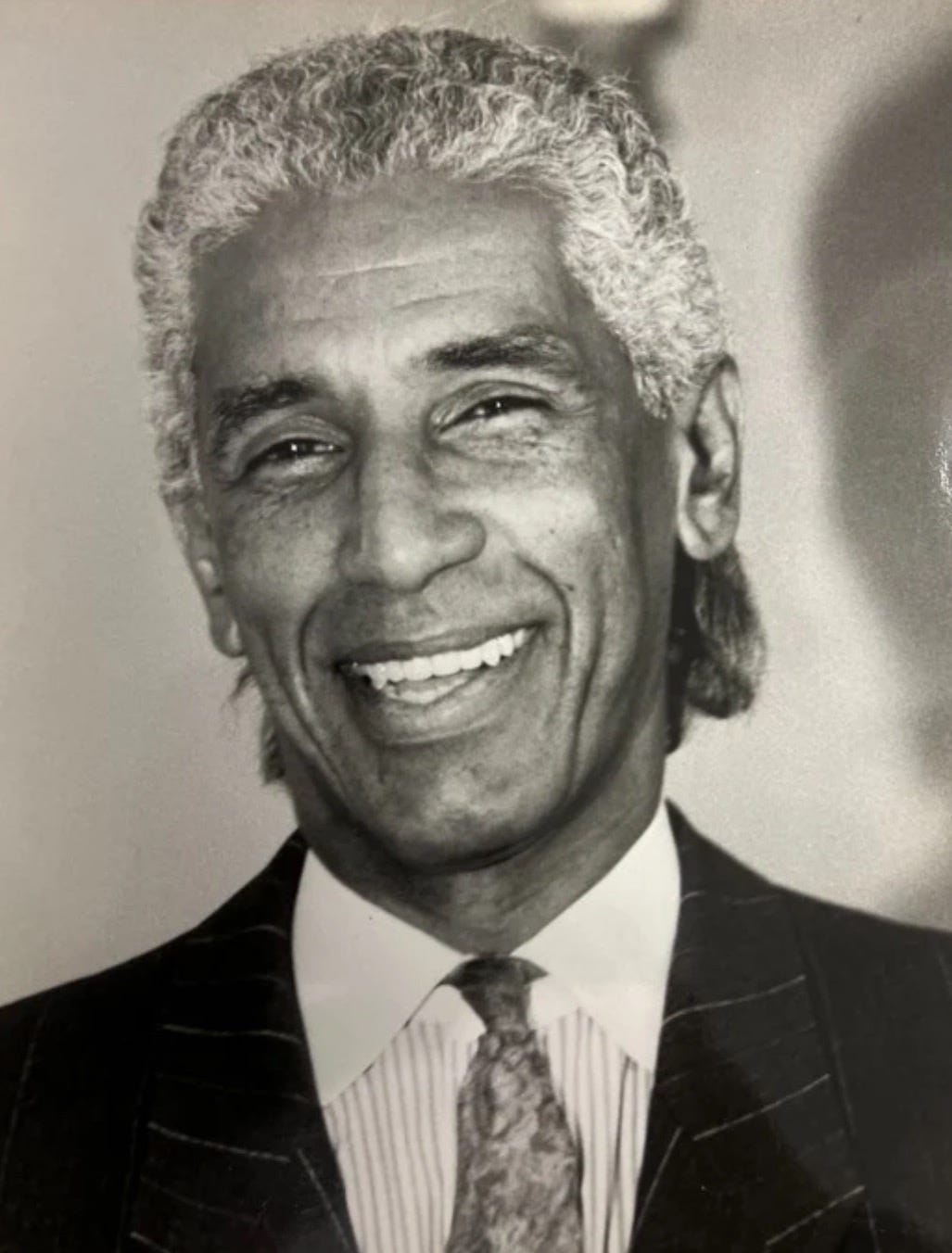
I got my first gray hair at the age of twelve. Several others joined it, making a small white patch in the back of my head, when I was in my twenties. I didn’t pull them out; they didn’t bother me. I knew that I’d gray early. My father had done the same, a full head of salt and pepper hair in curly waves that he often wore pulled back into a ponytail. Somehow my father made that look chic, even when an undeniable bald spot appeared at the back of his head when he reached his fifties.
So, I never had a negative view of gray or white or silver hair. I let it all come through until my mid-thirties, when I was approached by O Magazine to be in a feature on hair dye (I was in their database because I’d photo-tested for a different feature on emerging women poets the year before). So, in early 2013, I accepted the invitation to their studio in New York City, took the bus from where I lived in New Jersey and spent the day in a loft getting made up, dressed up, hair washed and cut, dyed and styled and photographed.
I never liked posing and tend to think too much to be very good at modeling, which is why I’m also not the best at dancing. I prefer the L.A. two-step, and the model walk I’ve had training for (I talk a little bit about being in a beauty pageant during middle school in my recent memoir). Forward movement, sustained focus? Yes. Posing, acting, freezing my facial expressions and gestures? Not a skill I have perfected, alas. I’d need to get more comfortable with being seen, or somehow to transform the discomfort into something else. What, I don’t know yet. Delight? Fun? I haven’t had enough practice with those things yet, either, really (thanks, depression!) but I’m working on it. And the idea of possibly becoming, as a friend suggested, a runway model in my old age holds a cheeky appeal.
Growing up in L.A., we met models and model recruiters everywhere. YM magazine did a shoot at my high school, and my sister and her friend ended up featured—my sister spinning her braids, her friend showing off her long nails and rings, both of them wearing crop tops and low-rise jeans. One of my classes did a fashion show at Neiman Marcus. I’d been approached at bus stops, on buses, at school, on the street, and by creeps hawking fake headshot sessions at the mall since my early teens.
But there was so much danger and lechery around the industry that when a classmate who’d just done a billboard for GAP said I should really consider modeling seriously, I shrugged it off. I didn’t have the kind of support system that could protect me, and my mother was strongly against it. She’d been around the L.A. music and film scene starting the 1950s, trying to make it as a jazz singer, and didn’t want her daughters anywhere near the men in the industry. She had stories upon stories about famous, powerful men and their bad behavior. And honestly, given constant street harassment and boys hitting on me, I wanted to focus more on my brains than on my looks. Showing off one’s beauty seemed like a recipe for harm. An exercise in extraction. You give away your looks for money, or false company, let them consume the external you, and then what? I felt suspicious, and as we’re seeing right now, for excellent reasons. (I could say much more about my being 17, 18, 19, and escaping various situations, safety intact thanks to my or my friends’ or sister’s intuition; maybe another time).
Fast forward fifteen-odd years, and my face and hair were spread centerfold-like in a print O Mag article that doubled as an ad for hair color. They colored my hair a reddish brown, and made it look like the grays had never existed. The stylist for the shoot kept asking me if I was sure about dyeing my hair, because I peppered him with questions. I had never in my life used hair dye until that point; I just wanted the information, to know how to take care of my hair. He finally just said: “Girl, don’t waste the pretty.” Gray hair on a woman in her 30s? Definitely not perceived as pretty, or even distinguished—which is how my father was characterized.
Lots of people I knew bought the magazine in stores when it came out, showing my photo to random folks, proud to know the face on the pages. I performed a smiling delight for social media and conversations, but inside, I felt detached, ambivalent, circumspect. Beauty didn’t feel like a thing to be proud of, even when I was caught up in the urgency to maintain it, even when I was invited into spaces in which it is celebrated, because we don’t have a real choice about our inherited looks. I wonder what the world would be like if we didn’t orchestrate cultural competitions over superficial traits that we don’t get to choose.
I think often of Linda Pastan’s poem “Ethics,” in which a professor poses an ethical question to a college class gathered in a museum. The question basically asks: what do we value, as a culture—great art, or old women? Then, the question narrowed: which great art, and which old women? When the young Linda-in-the-poem asks, “why not let the woman decide herself?” her professor drily replies that such a question “eschews the burdens of responsibility.” As if it’s irresponsible to conceive of an old woman having the agency to choose for herself what is of value, what is worth saving—as if her sacrifice must be considered inevitable, and right. And the younger woman’s questions: also dismissed, her inquiry deemed irrelevant.
I love the multiple perspectives in Pastan’s poem, the reversals in motion, how one museum visit finds her young and with a group, and the next finds her alone as “an old woman, or nearly so,” sitting in front of a Rembrandt, having become the subject of the question posed during student years. The ending is a wallop: “I know now that woman and painting and season are almost one / and all beyond saving by children.” That line break after “almost one” does a great deal of work there. Coupled with the “almost,” the break emphasizes the importance of and relationship between the woman, the painting, and the season. And despite that clear relationship over time, those “children” pondering the question are not only ill-equipped to answer it, but to even do the saving work at all. And should children even be burdened with that task? Where does that leave adult responsibility? Who gets to be protected, and who gets to decide what—and who—is worth protecting, is utterly distorted in this country. Pastan’s poem throws that sinister fact into sharp relief.
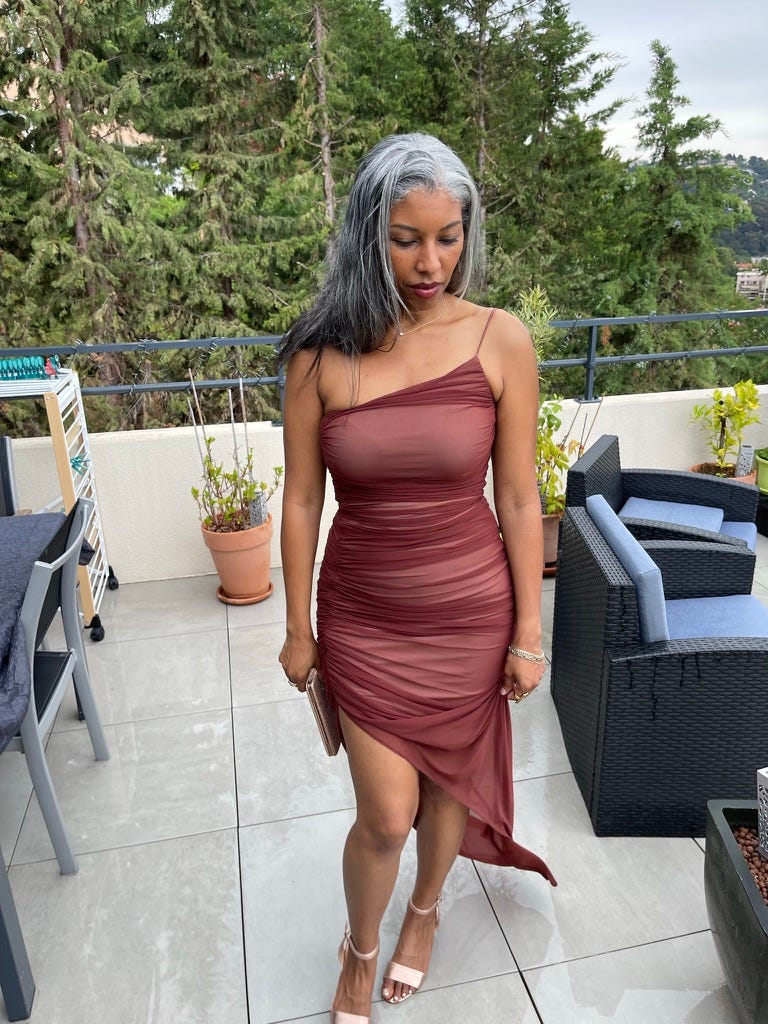
Fast forward another decade in my life and a pandemic during which my hairdresser came down with a terrible SARS CoV-2 case—and has yet to fully recover her sense of smell, nearly six years on—and I stopped coloring my hair. My hair grows quickly, and I’d started using dye every two to three weeks during 2018 and 2019, the last two years of my PhD—a busy time that included a book tour, a new tenure-track job, and my son going away to college on top of dissertation writing. I carried black hairspray and a root brush in my purse to use in a pinch, and used box dye if I couldn’t get in to see my stylist. Coloring my hair had become this Thing I Had To Do that took up precious time, money, and headspace. And so, deprived of places to go and the person who helped me look good getting there in 2020, when I had a new book to promote, I got to know my real hair.
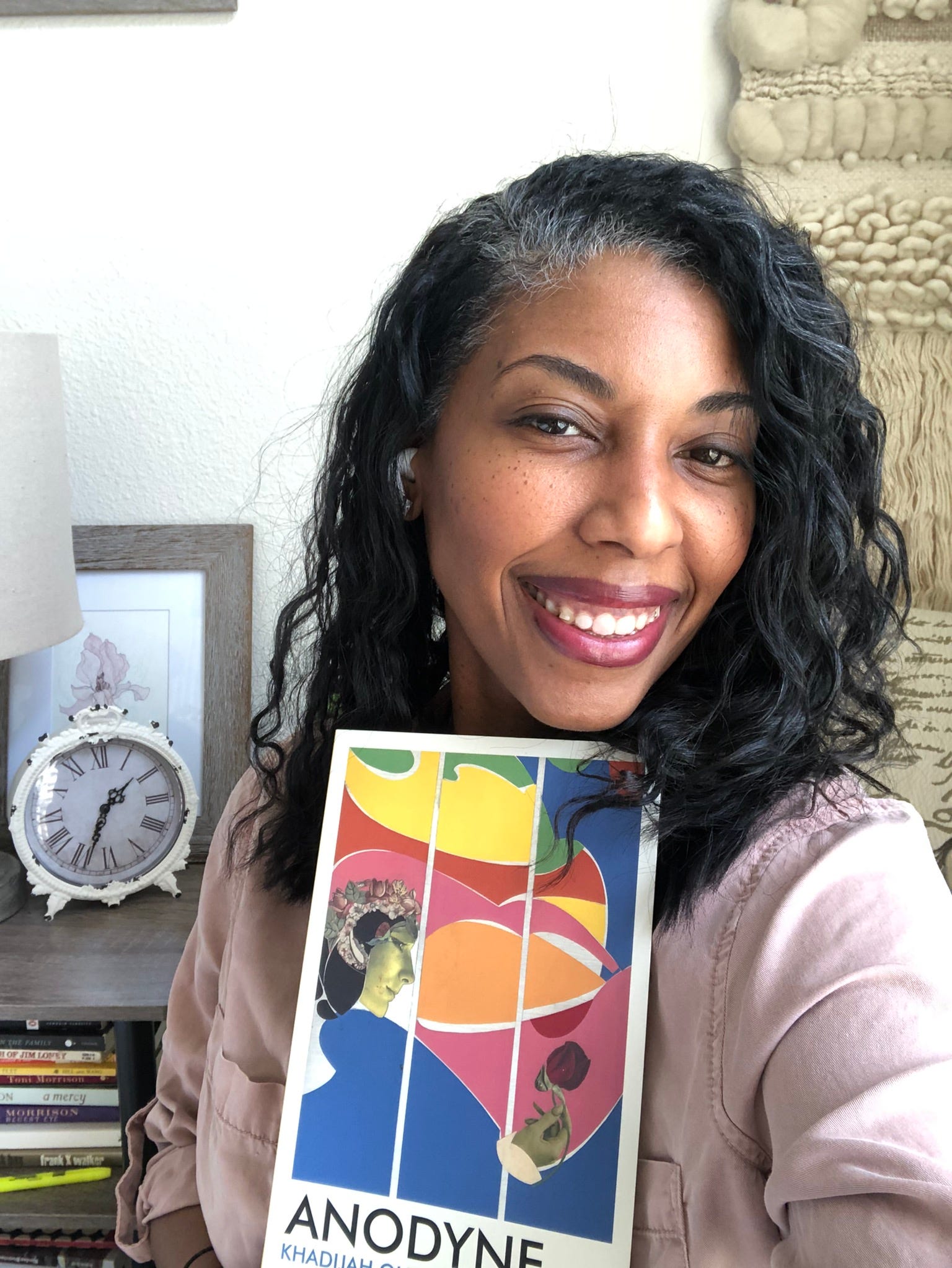
I researched the grow-out phase, how women made it through the awkward “white hat” look, or “gray cap.” I didn’t want to cut my hair short. I wanted bold, witch-long white hair, at the risk of seeming scary. I wanted my hair to be defiantly beautiful. When it wasn’t braided (unfortunately, the ombré synthetic hair I used has been shown to have toxic qualities) I let the growth show, despite other people’s discomfort with it. Not hiding my physical transformations as I aged meant that people I encountered in public might have to face their own aging process. Not everyone was ready. The lack of validation, the attempts to shame me for making the choice to stop coloring my own hair, however, only made me more determined to be public about the process. Letting my gray hair slowly unfurl was an exercise in self-acceptance that I deeply appreciate.
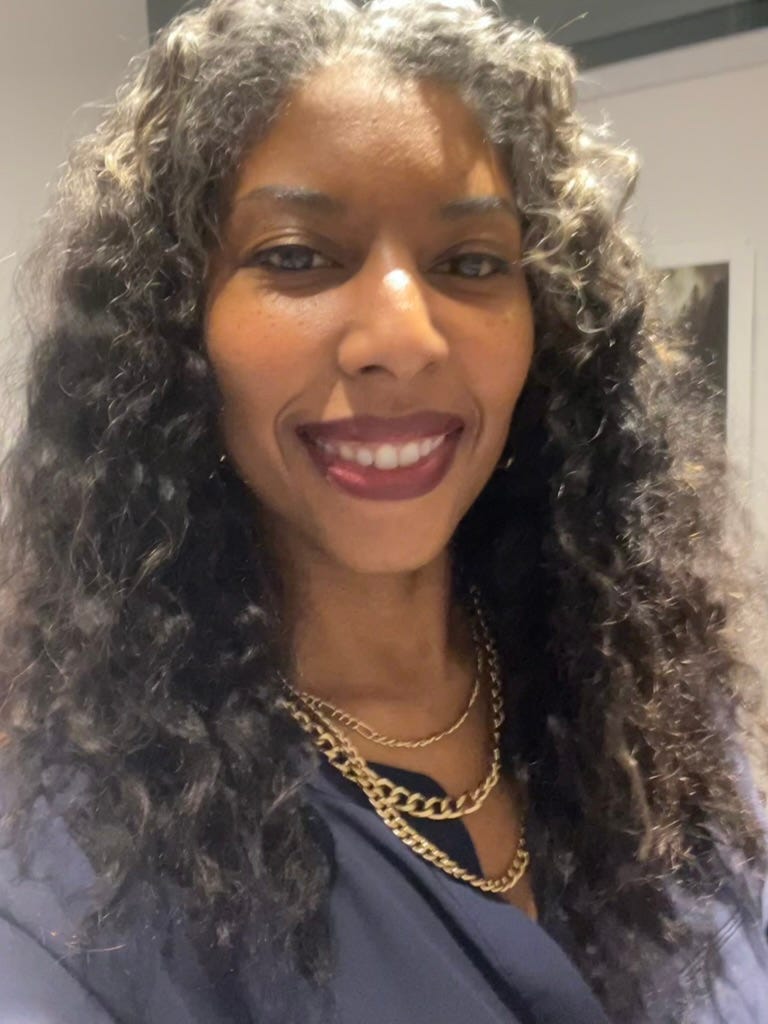
It does help that much of the gray in my hair is a platinum-like, silvery-white blend that my students tell me gives them Storm vibes. In December 2021, I tried bangs, cut some of the length. What started as a giving-up of costly maintenance became an empowering act. I wear my hair any way I want: curly, straight, tied back, pulled up, loose and free. I let it grow out in length, let it grow out in color, doing the opposite of what “old women” have been told to do.
I let my hair be nonconformist—like me.
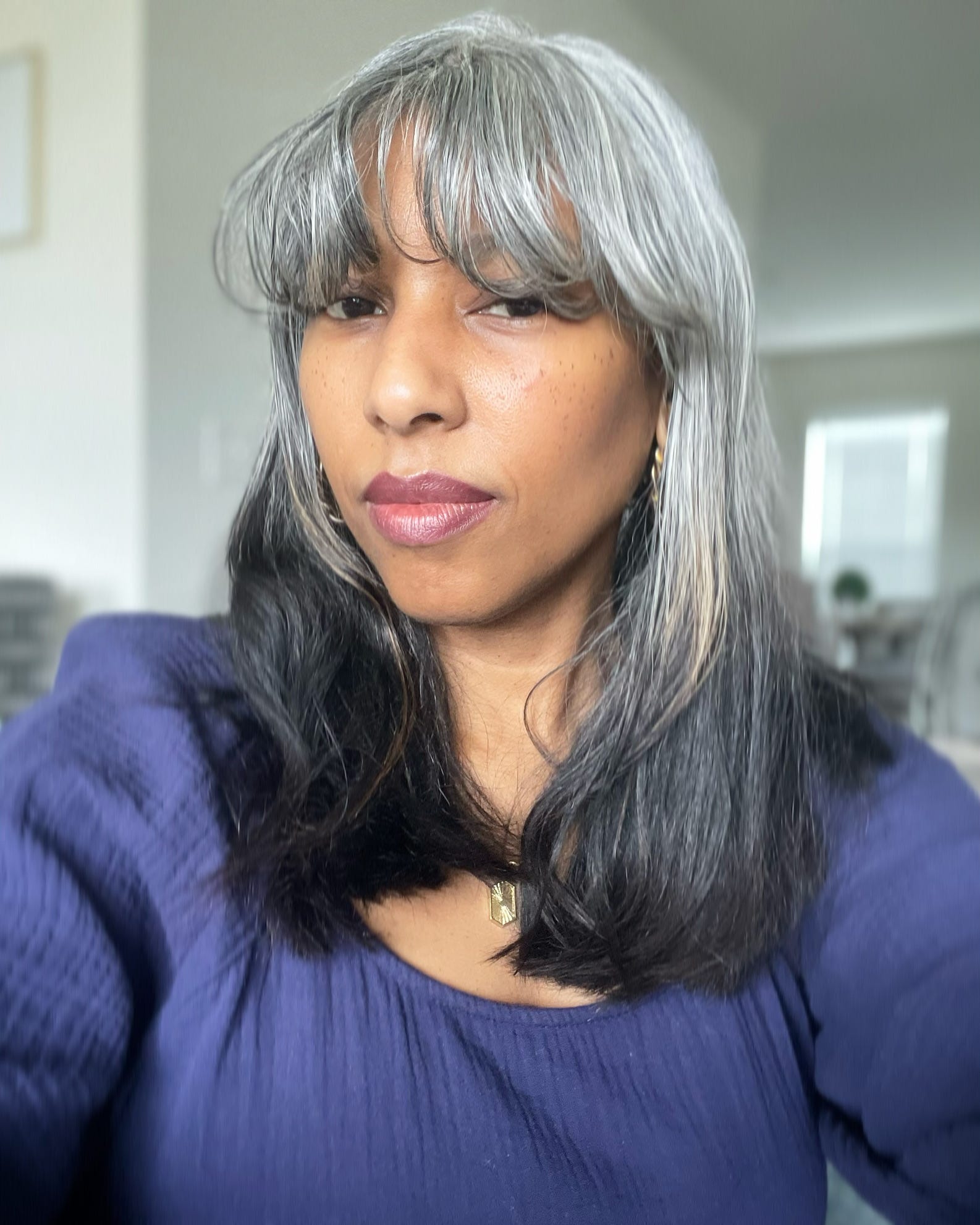
When I was younger, I shied away from the attention my long black hair gave me because that attention often turned negative. Aside from regular street harassment, I encountered jealousy and backhanded compliments in encounters with both strangers and people close to me that taught me to keep my guard up. I muddled through male desire, possessiveness, and entitlement that I felt ill-equipped to handle; I either performed mental gymnastics or ran away. Enough people—family, friends, and strangers—had made me feel bad or insulted me because of how I looked, calling me stuck-up or conceited if I didn’t want to date or hang out, that beauty didn’t feel like a connecting point, even if it had initially opened doors in certain situations. More often, it felt like a barrier, made of presumption. I started to hate when people gave me compliments about my looks. I didn’t trust them not to flip it around into something that meant rejection, underestimation, disdain, or even harm.
In Ways of Seeing, John Berger writes: “A woman must continually watch herself. She is almost continually accompanied by her own image of herself. Whilst she is walking across a room or whilst she is weeping at the death of her father, she can scarcely avoid envisaging herself walking or weeping. From earliest childhood she has been taught and persuaded to survey herself continually.” How to disrupt this ingrained self-surveillance practice and remain intact?
My natural defiance and learned hypervigilance meant that I eventually started avoiding social situations—shrinking, hiding, dressing down, and after a particularly violent incident, isolating. I reverted to my childhood tomboy tendencies. It took a long time for me to dress in anything other than oversized sweatshirts and baggy jeans. According to my wounded logic, if I dressed like a boy, maybe gross men would leave me the fuck alone. But clothes mattered so much less than I thought; a different question popped up with regularity when I started venturing back out into society. People kept saying, “I can tell you’re pretty. Why don’t you dress like it?”
Why indeed? When I was ready to step out of my violence-induced frump-funk, I did so into clothes so daring it intimidated most of the usual suspects. My biggest flaw was poverty, and I’d studied fashion; so, even with my financially-constrained wardrobe, I knew how to highlight my most flattering aspects. I used that knowledge to armor up. I felt like I had to, to keep my peace, to keep people from touching my hair (or me) without my permission. It worked, to a degree, at least during the day. But I still couldn’t always avoid getting into real-deal arguments with perfect strangers—regardless of their gender—about things like whether my hair was real or a weave.
So, I had an attitude. When my voice wasn’t loud, my face was. The anger wasn’t really “me,” however, and after awhile it took a toll to perform it, even as protection. Sometimes external perception, when relentless enough, can distort our self-image, and by extension, our behavior. No matter what we look like, I think survivors especially have to be persistent about staying in alignment with who we actually are, and not what other people think we are or want us to be—even if we can only be fully ourselves safely when we’re alone. Audre Lorde said it best: “If I didn't define myself for myself, I would be crunched into other people's fantasies for me and eaten alive.”
Now, at my very grown age, it feels defiant to retain my optimism, my naturally sunny disposition. It feels wonderful, especially now, to hold more grace than fear. I’ve learned a lot about transmuting anger (thanks to something Joy Harjo said, in answer to one of my questions, in New York a decade-plus ago). It helps that I’m not dependent on public transit, and wear over-ear headphones in most public spaces in the U.S., but still; I let myself appreciate the appreciation more. I won’t waste the pretty of this hair color that is all mine—no dye, no highlights, but lots of care.
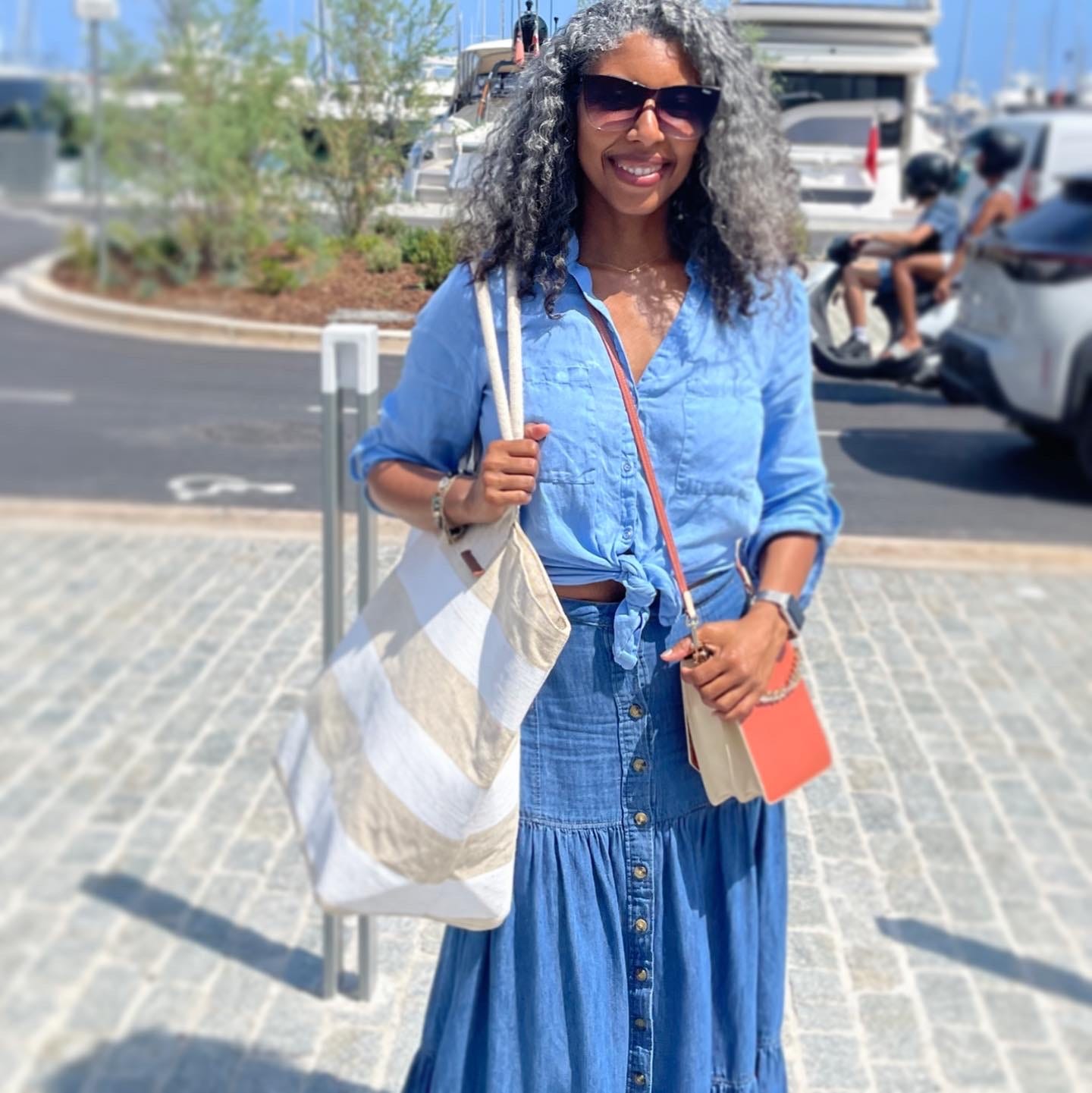
These days, instead of getting asked aggressively if my hair is real, people want to know—without the aggression, thankfully—if the color is real. Ha! That questioning of the authenticity of my appearance used to bother me so much, as if the default belief is that anything beautiful—particularly if it’s unusual—has to be purchased or enhanced (not that there’s anything wrong with that! Why do we police other people’s appearances so tirelessly? I refuse to understand). The only money I spend on this hair is on two kinds of shampoo (purple, and moisturizing), Ayurvedic oil, three kinds of conditioner (according to the season/use), and professional styling/cut/deep conditioning treatment every season.
Not everyone knows how to maintain this color, I’ve found; one young stylist had the heat too high on a flat iron, and burned a section of my whitest hair a sad yellow. I had to switch sides for the part, cover up the burned strands with another section until the yellow faded. I was lucky it wasn’t permanently damaged. I’d warned the stylist, but she didn’t listen; my hair paid the price.. She did apologize, seeing the damage, and I hope she learned for the next person.
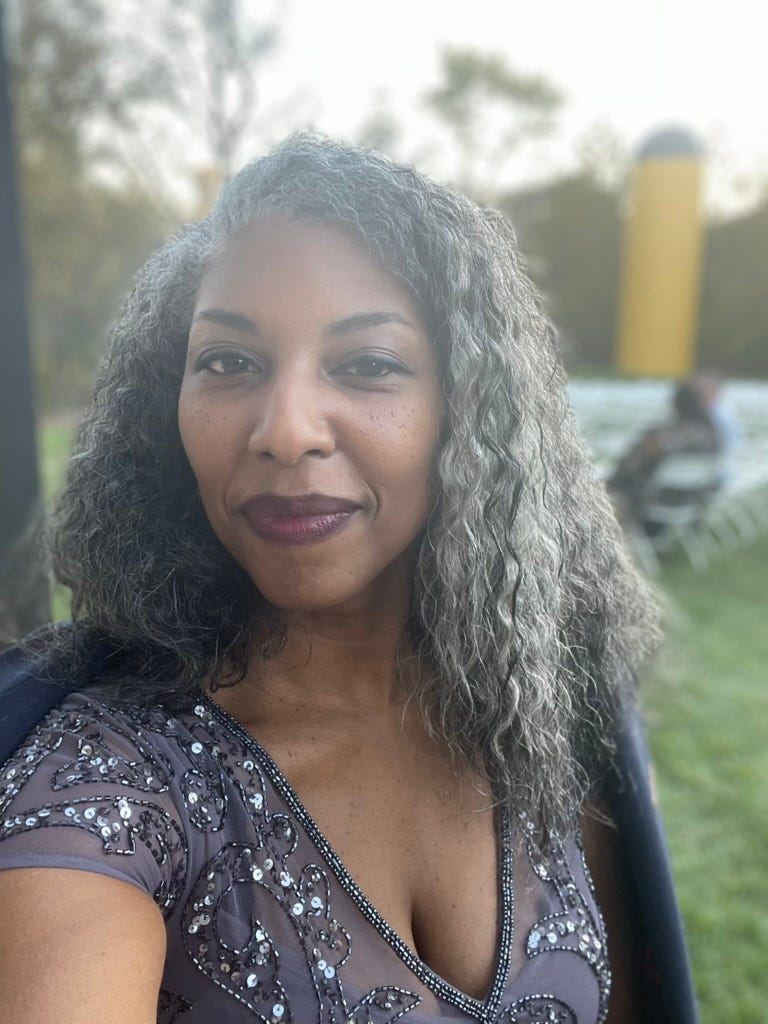
Anyway. Everywhere I’ve traveled since I let my hair turn all the way gray, I get compliments, whether it’s curly or straightened. I was somewhat early to the trend—and it is now a trend—and as time has passed, I’ve come to accept those compliments without feeling guarded. It feels subversive somehow, to go gray in the enhancement era. It represents an acceptance of aging that society actively opposes, in policy and in social practice/belief.
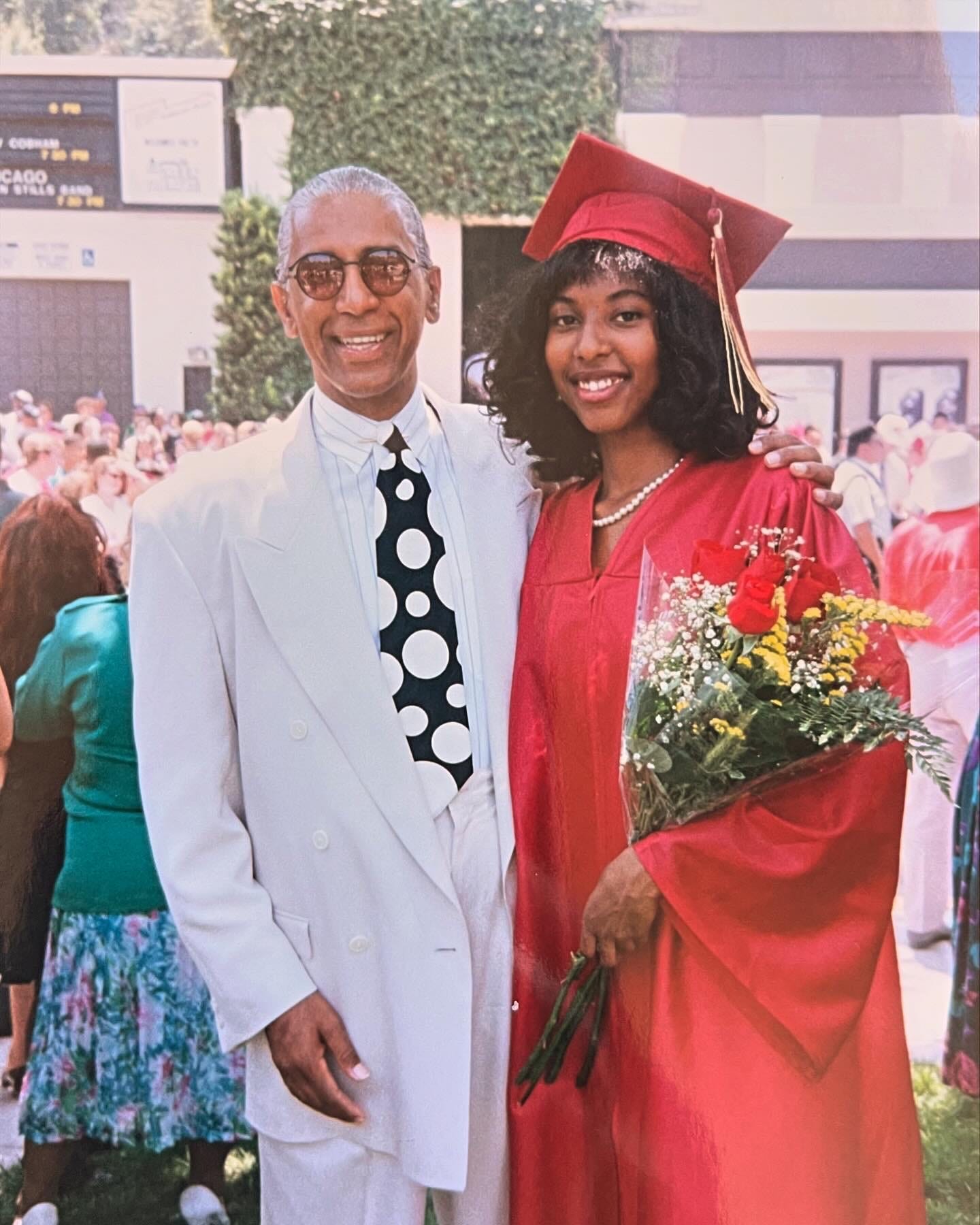
I feel lucky, then, that people are more open to appreciating natural looks like mine. Instead of exhortations or side-eyes favoring a coverup with dye (like I got relentlessly during the grow-out phase), I’ve had almost all positive interactions—usually at least once a day—when I’m out in public. It’s lovely. But I can’t let positive hair-focused comments define me, either. Reflexively I deflect the praise to my father, whose hair color and texture I’ve inherited. Unlike me, he had no trouble being seen! His hair turned many heads, as did his matching silver Porsche 911 he’d bought used and fixed up, whether he slicked his hair back or let the curls loose. Since he died ten months ago, when I think about how flashy he was, I remember how much I disliked his “floor-showing” as my mom called it—a Michigan way to say showing off. And I regret feeling so embarrassed by it.
I wish for the world to change enough that more of us, women especially, Black women especially, can feel safer showing off. I wish for us all to understand the difficult beauty of women’s physical changes over the course of our lives, to respect how we appear in public space at each stage of evolution, however imperfectly we appear, and to support us when those changes are painful or damaging or exhausting. In my dreams, I imagine a collective way of celebrating postmenopausal life—and the gray hair that can come with it—instead of hiding or dreading or shaming it.
My favorite encounter was in New Orleans in summer 2024. A woman at the French Market stopped me in the middle of the walkway, saying “You make me want to let my grays come through.” We chatted for a few minutes, and I could tell that seeing me rock this old lady hair color with style had unlocked something powerful for her.
“Do it!” I said.
I hope she did. I know I will.
Three Recommendations:
A powerful essay by Xander Gershberg, a young poet and legal observer, and one of my former MFA students, who is living in Minneapolis.
Fantastic article on Black women and aging: “Black Don’t Crack Stresses Me Out”
If you’re on IG, especially if you’re letting your hair be itself as you age, follow silver-haired models/influencers like Luisa Dunn and Tennille Jenkins for some style inspiration
I used to dye my hair because it was fun. Then one day I wanted to see my hair and it was all this gray in my head. I was excited and haven’t dyed it since. Getting older has been so freeing. Thank you for sharing.
Many years ago, when I was about 19, I went to a hula (Hawaiian dance) festival in a beautiful outdoor venue. Under the canopy of a giant, sprawling tree, in the front row of one hālau (hula school), was a young woman—a stunning, mesmerizing dancer—with long, wavy, thick sliver hair. She was a vision. And, in that moment I knew: despite being raised in culture and family where aging for women was something to dread, avoid, and cover up, I was *never* going to dye my hair, ever.
I am 44 now and my silvers, whites, and grays are coming in so beautifully. Sometimes, I think about how gorgeous my grandmothers shock of white hair was, the dignity with which she carried it, and I feel so proud to be growing slowly but surely into my own elderhood.
Final note: you were a “suggested follow” for me. I checked out your substack because when I saw your profile picture I thought, my gosh, she has gorgeous hair! And here I am. Thank you.